A not-for-profit project to make education accessible
A patient tutor for every student in Grades 9 to 12
WiiLearn teaches the approved school syllabus one step at a time. Students get explanations, worked examples and practice questions, and every next session is planned around what they found difficult last time.
Student app in development
The early preview uses sample content and pre-written tutor replies. Progress is saved only in this browser.
For students who don’t have a tutor at home
Many students in Grades 9 to 12 can’t pay for coaching, and many schools are short of subject teachers. WiiLearn gives these students steady, one-to-one support between classes.
Our mission
Reaching students in ghost schools
Some schools exist on paper but don’t run, often because there is no teacher. The children nearby lose years of learning. WiiLearn is a not-for-profit project to help bring learning back to places like these.
We work with NGOs on the ground and are in discussions with government education bodies about using WiiLearn in ghost schools. Students there would follow the syllabus with a patient tutor, guided by a local teacher or facilitator.
- NGO pilot with Taleem Sabke LiyeBeing prepared
- Government education bodiesIn discussion
- Use in ghost schoolsIn discussion
Not for profit
WiiLearn exists to widen access to education, not to sell coaching.
Made for low-resource classrooms
Lite mode runs on low-cost phones, shared devices and slow mobile data.
People stay at the centre
A local teacher or facilitator guides each group. The tutor supports them and shows where students are stuck.
How a study session works
The same loop runs every time a student opens the app. Each pass makes the next session fit the student a little better.
Choose class and time
The student picks their class, subjects and how much time they have each day.
Get a study plan
A weekly plan is built from the approved syllabus for that class.
Learn with the tutor
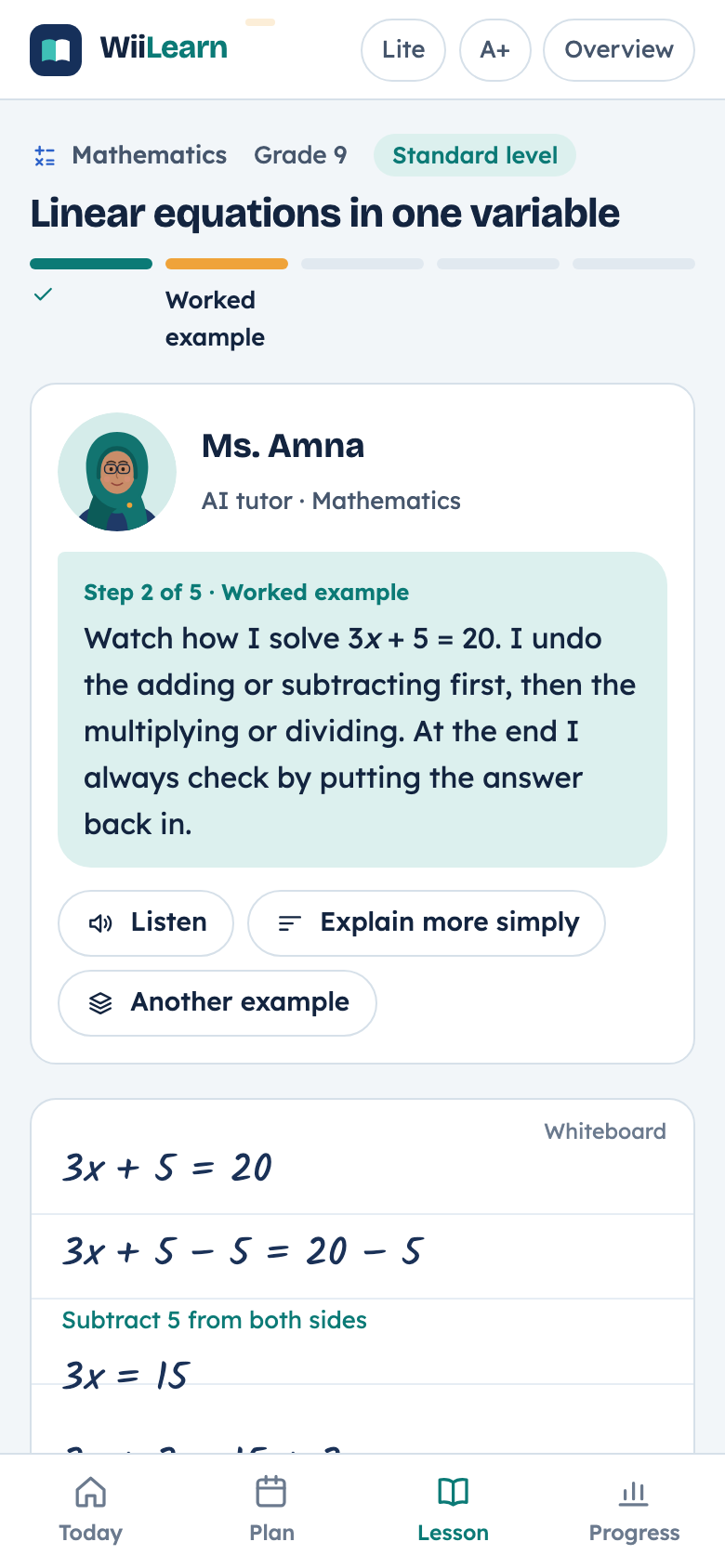
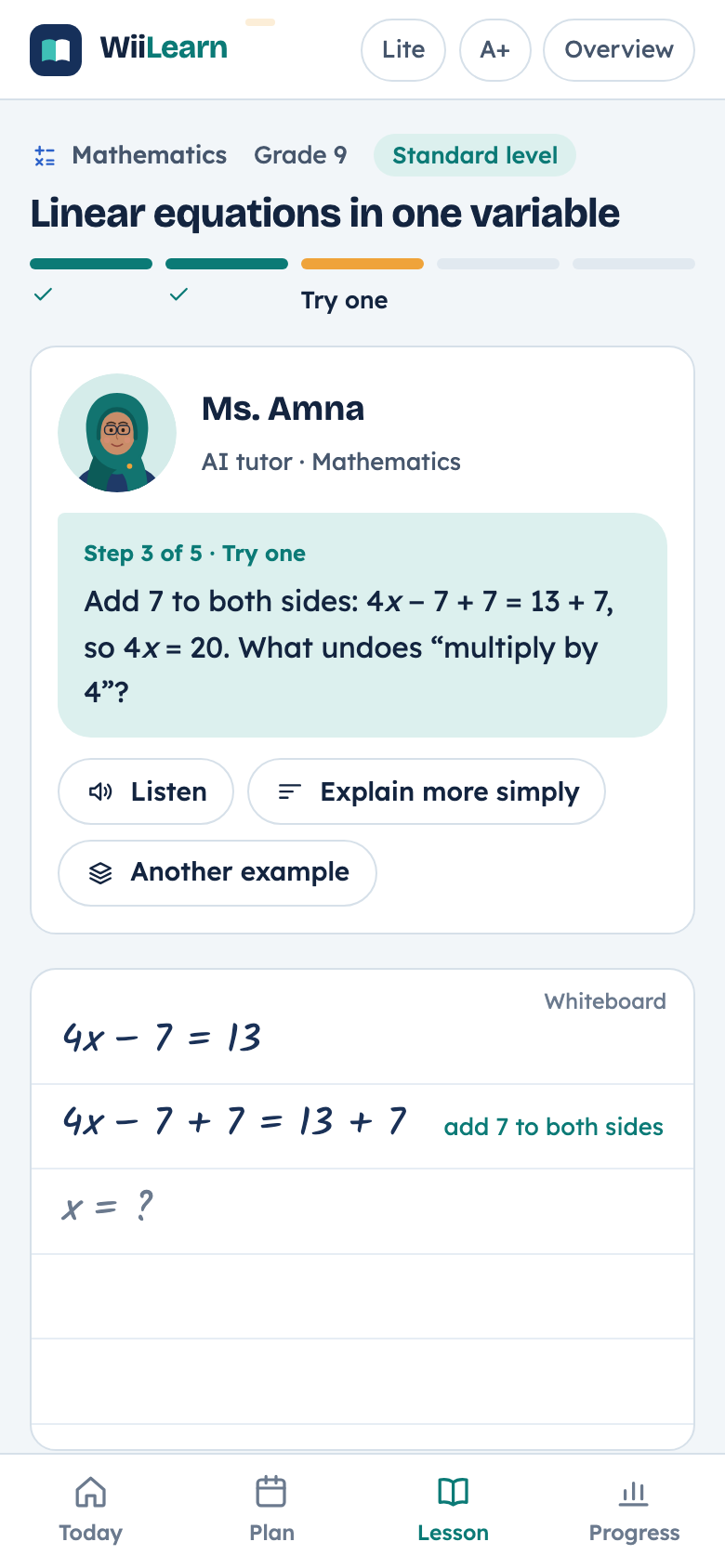
The tutor explains, works an example and asks guided questions.
Practise and take a check
Independent practice first, then a short quiz with hints switched off.
Find weak areas
Answers and mistakes are recorded for each topic.
Next session adjusts
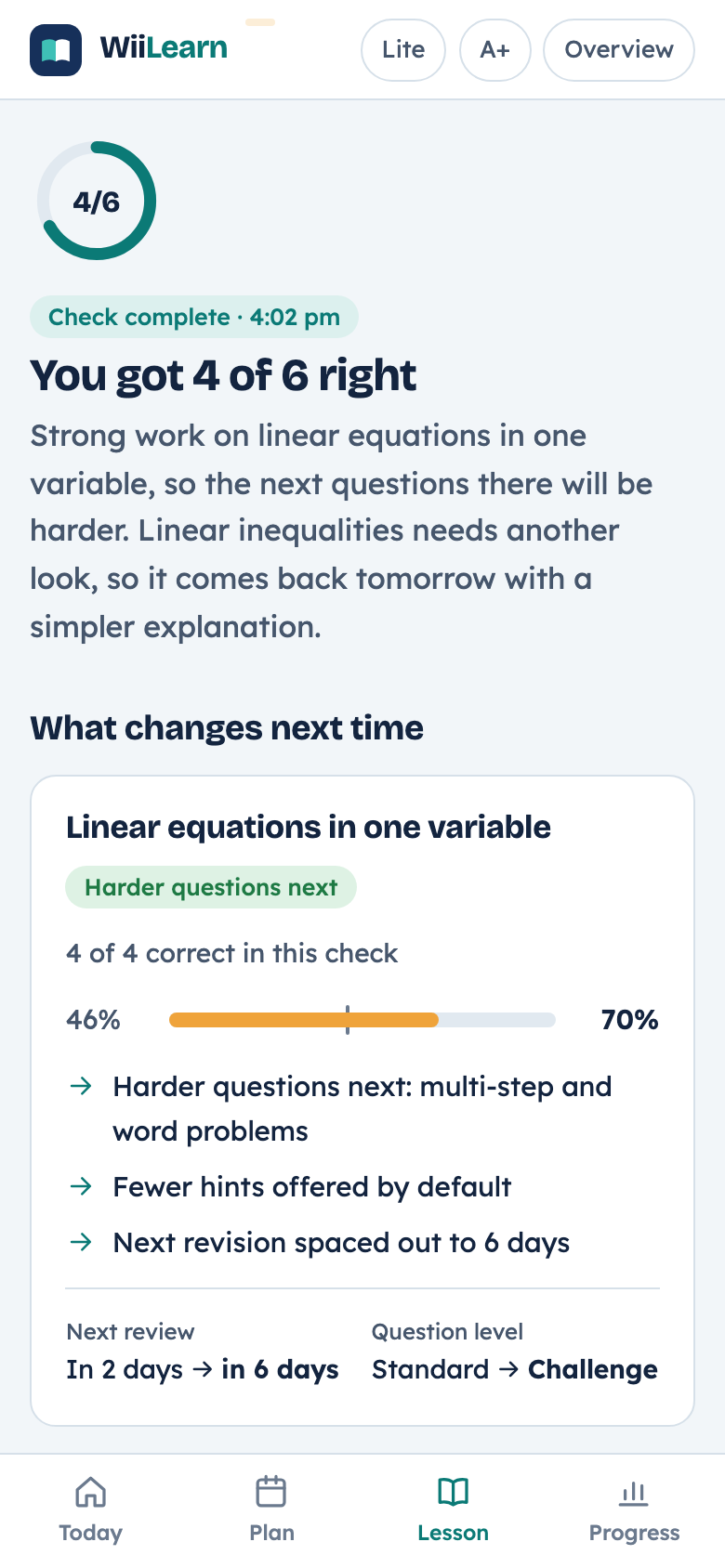
Weak topics come back sooner. Strong topics get harder questions.
Progress is remembered
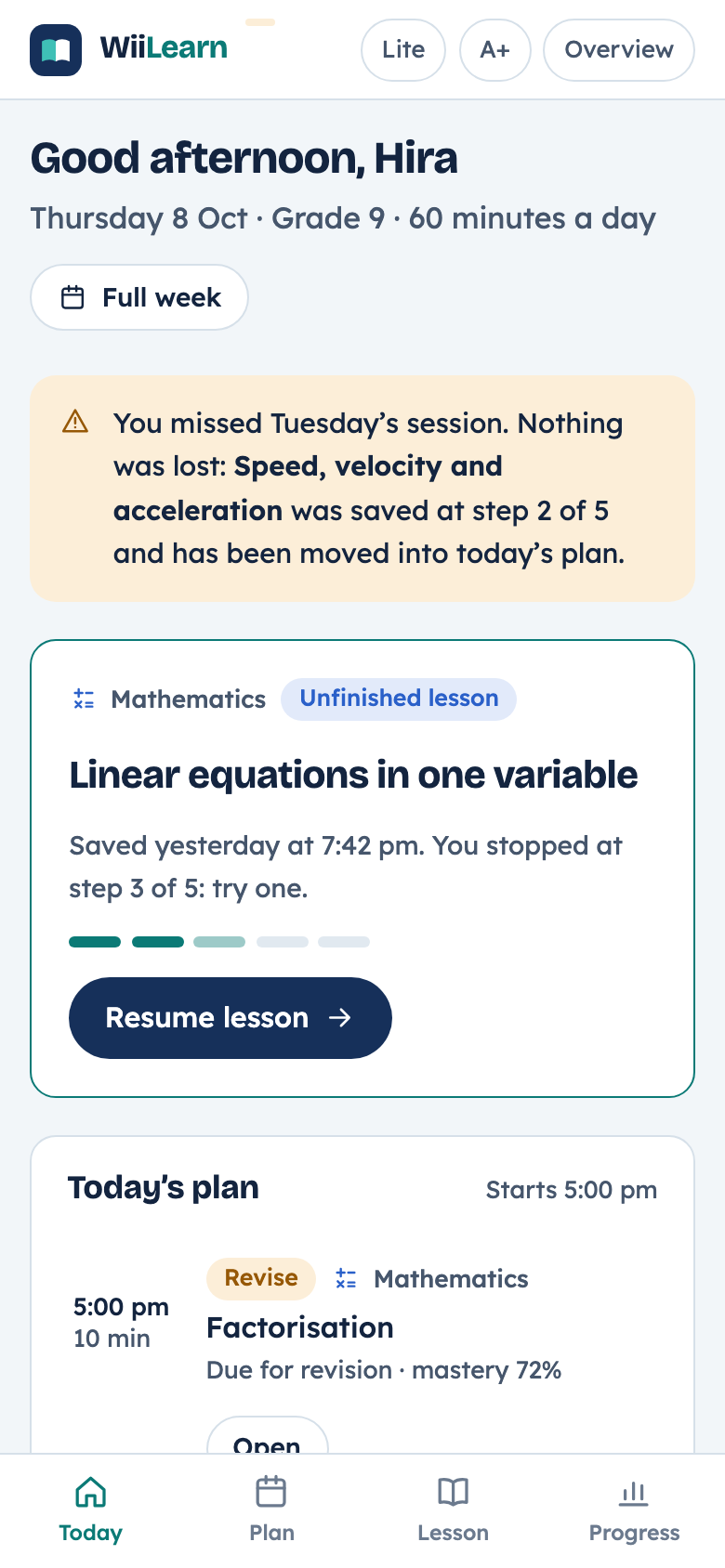
Unfinished lessons, scores and repeated mistakes carry over to the next visit.
Inside the student app
Screens from the early preview, at phone size. The app is still in development, and every screen is designed for a small phone first.
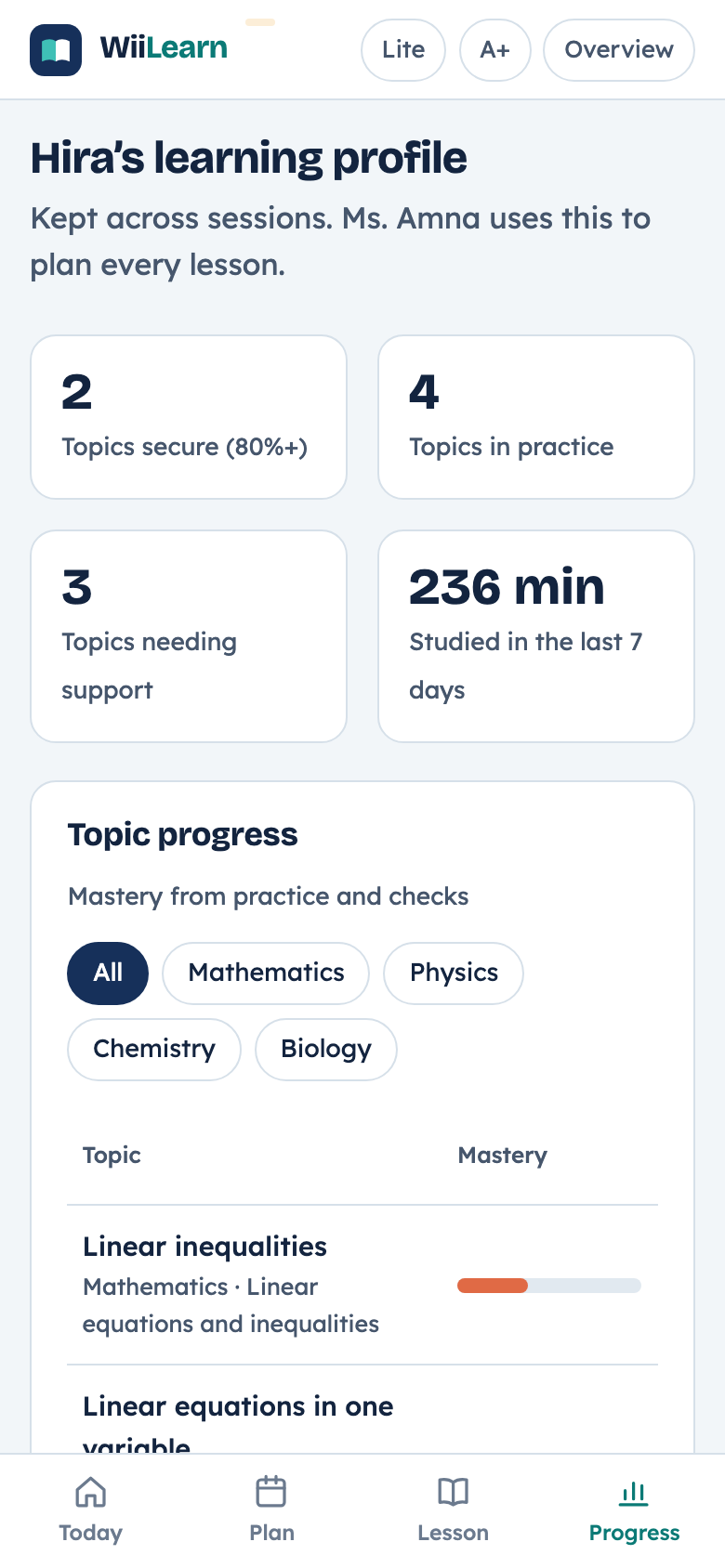
Swipe for more screens →
How the next session changes
These rules decide what the student sees next time. The app shows the reason next to every item in the plan, so students know why it looks the way it does.
| When the student… | The tutor… | The study plan… |
|---|---|---|
| struggles with a topic Score below 50% | explains it again more simply, with a fully worked example and smaller steps | brings the topic back the next day at foundation level |
| repeats the same mistake Seen before | names the mistake and shows two more examples of exactly that step | moves the revision earlier, even if it was days away |
| is getting there 50–79% | gives more guided practice at the same level | schedules a revision in two days |
| understands the topic 80% or more | moves on to harder, multi-step and word problems, and offers fewer hints | spaces out the next revision, for example from 3 days to 6 |
| misses a session No activity | keeps every step already completed | puts the unfinished lesson into the next session, starting at the saved step |
What the tutor will and won’t do
The goal is learning that holds up in an exam hall, without the app.
Support for teachers, not a replacement
In a class of forty, a teacher can’t see every student’s working. WiiLearn gives teachers a weekly view of which topics the class found hard, which mistakes keep coming up, and who needs a check-in. Teachers can leave notes that change what the tutor focuses on.
Class 9-B · Mathematics · this week
Sample dataAverage mastery by topic
Most repeated mistake: inequality sign not reversed when dividing by a negative number
Pilot partners
The first pilot runs in partner schools with support from two organisations. We are also in discussions with other NGOs and government education bodies about reaching ghost schools.
Partner roles are limited to the initial pilot described here.
Learning that remembers where each student left off
WiiLearn is a not-for-profit project in development. We’re working with NGOs and talking with government about bringing it to ghost schools. Try the early preview to see a full lesson, a quiz and how the next session changes.